The Learning Circle · Episode 19 · Parenting & School Leadership
Why Parents Are the Key to Education Success
Ms. Aditi Misra has run schools for nearly four decades and raised children through the same years. Her argument is that the partnership between a school and a parent is not a nice-to-have to be switched on in a crisis — it is the thing the child stands on. And almost every conflict inside it can be resolved by conversation.
The video loads only when you press play — no third-party cookies are set before that.
The short version
For school leaders: what changes when parents are treated as partners in the academic conversation rather than an audience for it.
Ms. Misra speaks as a principal and as a parent, and she keeps collapsing the distance between the two. Schools that treat parents as adversaries lose the child; schools that treat them as partners get a child who feels safe because both adults are visibly on the same side.
The same principle runs through the harder subjects. Academic pressure eases when a child knows love is not proportional to marks. Career confusion eases when a child gets a reality check instead of an instruction. Device dependence eases when there is something better on offer at home — and when the parent is not on a phone at dinner either. The traits that matter most, she argues, are never taught. They are imbibed, by watching.
Key facts at a glance
- Guest
- Ms. Aditi Misra, School Director, DPS International, Gurgaon; Founder Principal, DPS Gurgaon
- Central claim
- The school–parent partnership is not optional; the child is what breaks when it fails
- Conflict method
- The Conversational Catalyst — trigger, pause, shared reality, alignment
- Device rule
- No personal device under about 14; supervised research in a common area only
- Named risk
- “Digital dementia” — memory loss, sleep disruption, forgetfulness, loss of empathy
- Daily practice
- The Dinner Table Diagnostic — best part, worst part, answered by parents too
- Future skills
- Adaptability, collaboration, creative and critical thinking, deep empathy
- Ultimate metric
- Joyful learning — if the child is not experiencing joy, adjust the ecosystem
In her words
“I have never seen parents as adversaries ever in the school. They are my partners.”
“You don’t get it, it doesn’t bother me in the least. You still remain my son, I will still love you.”
“Please keep that child closest to your heart. It will be horrible if parents and children drift apart because of these differences.”
Twelve things worth taking away
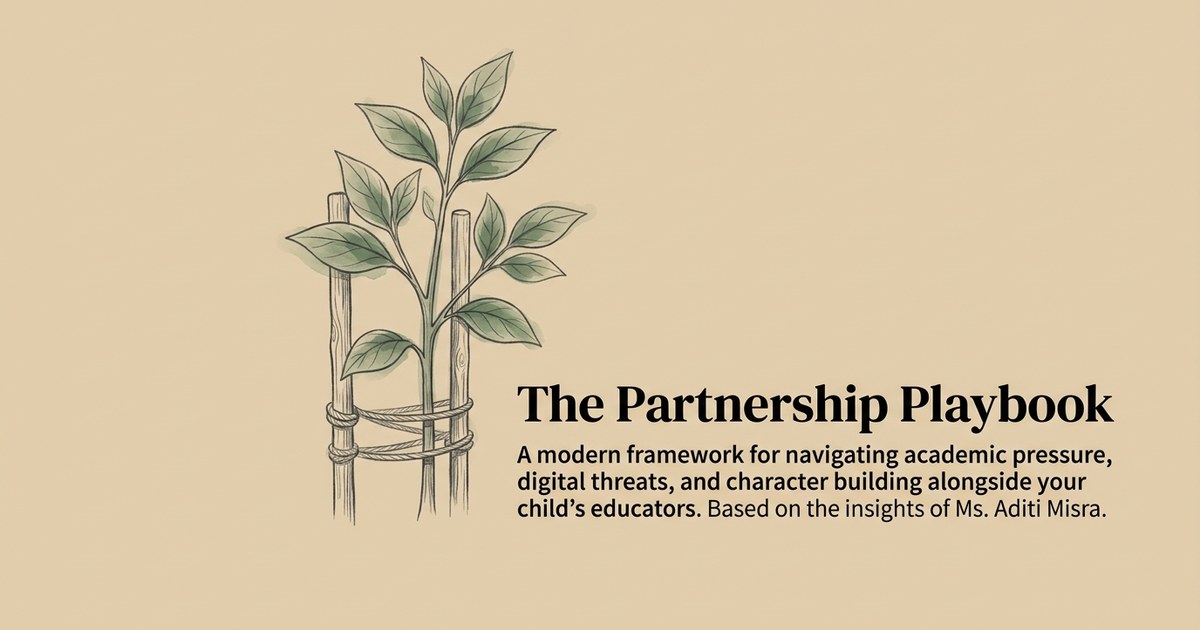
Each one below is illustrated with the corresponding page from The Partnership Playbook, the framework built from this conversation.
-
Parents are partners, not adversaries.
On her first day as a principal, Ms. Misra was responsible for 900 children and watched dispersal descend into chaos. Two parents stepped in and calmed the rest. The lesson stuck: when parents are on the school’s side, everything downstream runs more smoothly.
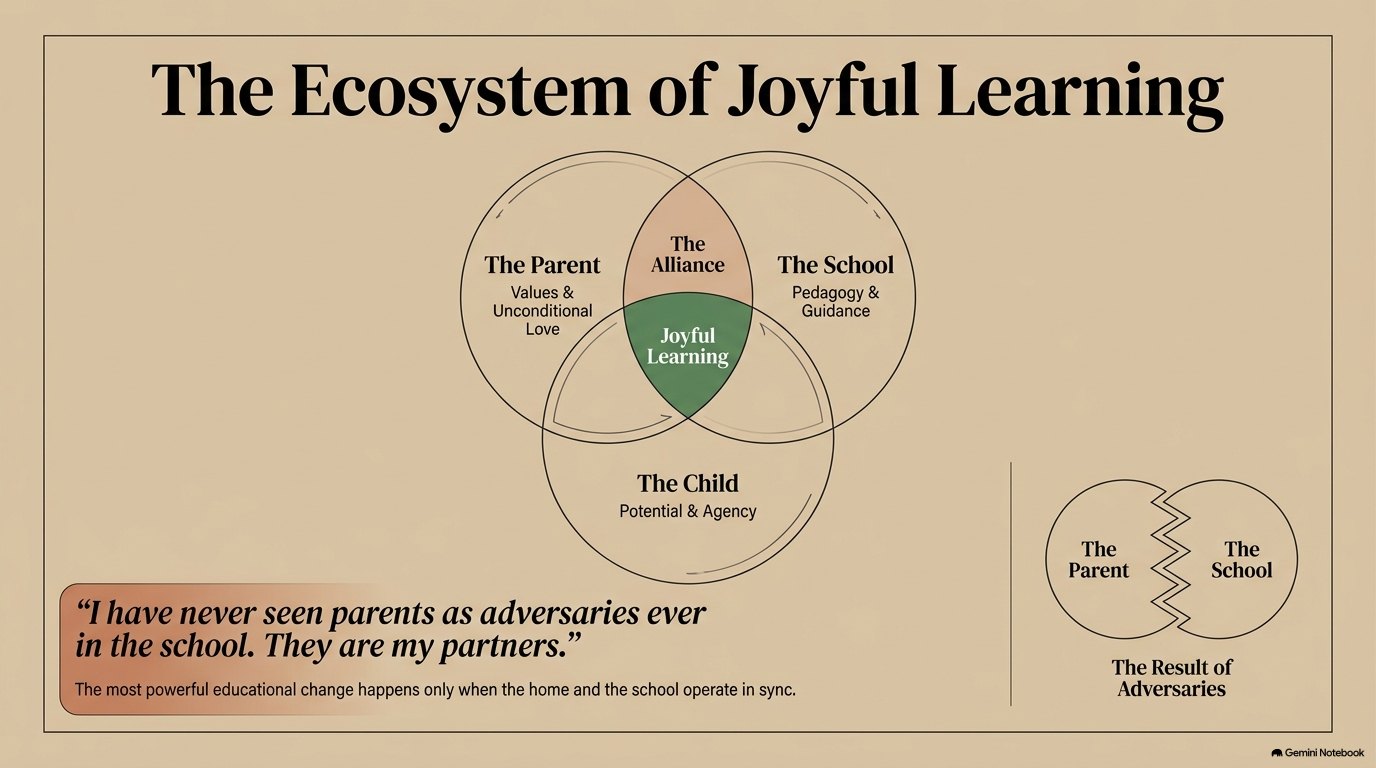
The alliance only produces joyful learning where all three circles overlap. Where the parent and the school pull apart, the child is what tears. -
Conflict is resolved by conversation, at every level.
During a dispute over a fee increase, the school did not go quiet. It opened the auditorium and walked parents through the expenses line by line. One parent spoke up for the school’s need to retain good teachers, and the tension broke. Her estimate: transparent conversation resolves nearly every conflict.
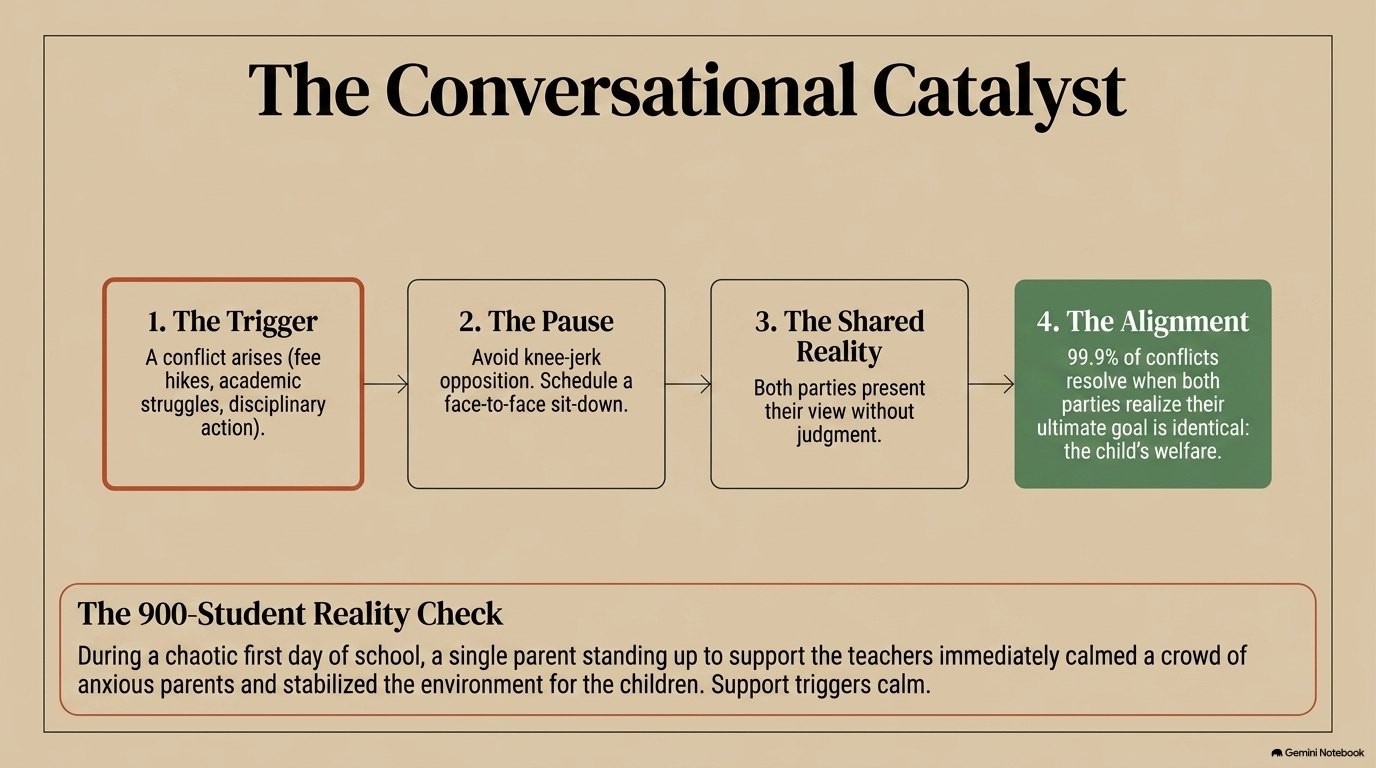
The sequence matters more than the argument. Nothing is won at step one — the resolution arrives at step four, when both sides notice they wanted the same thing all along. -
Success is not “genetically inspired”.
Children of high-achieving parents do not automatically become toppers, and children from the most basic backgrounds routinely excel. Treating achievement as inherited quietly damages both groups.
-
Love cannot be proportional to marks.
A child’s confidence rests on knowing the affection at home does not rise and fall with a report card. Equating happiness with high marks, a bigger house or a bigger car is the error; the metric that matters is the happiness quotient.
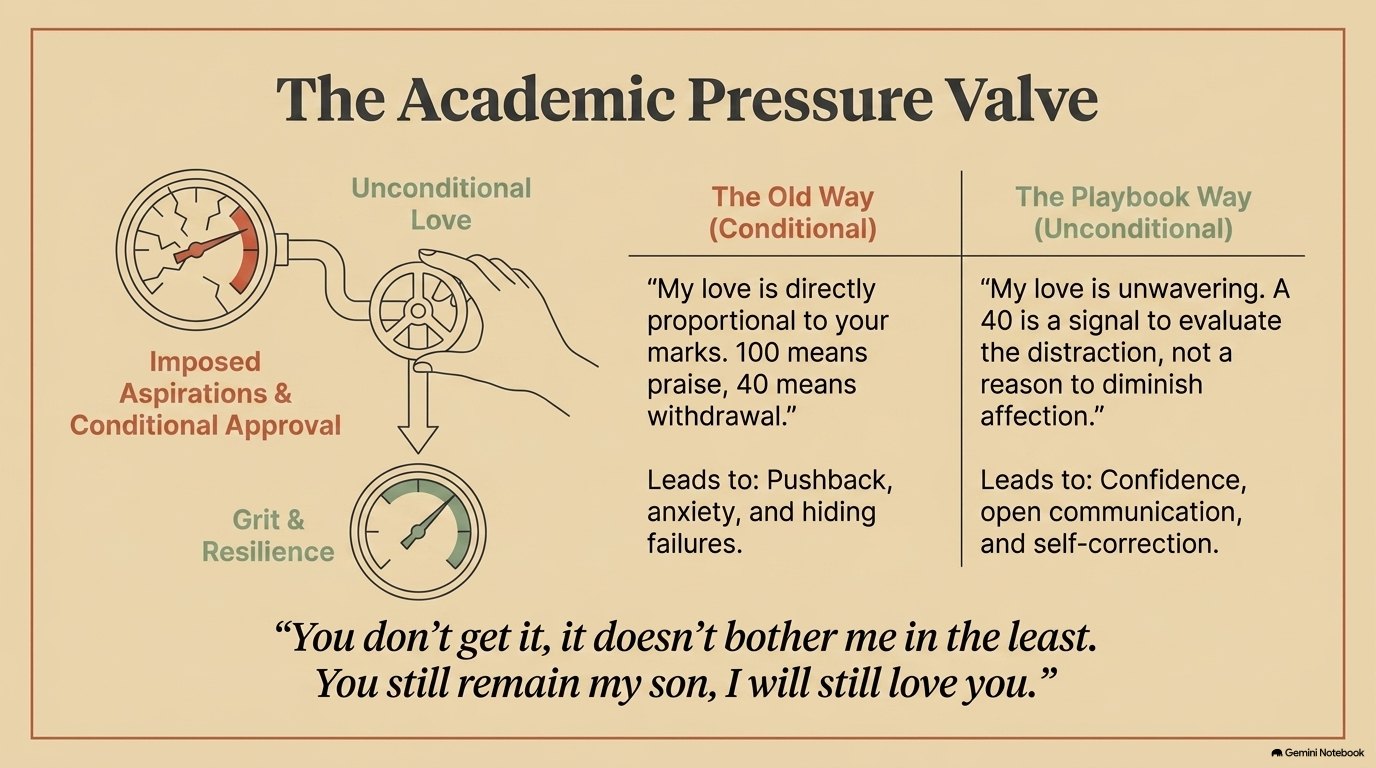
The same 40 on a test, read two ways. On the left it triggers withdrawal, and the child learns to hide failure. On the right it is a signal to look at what distracted them — and the child keeps telling you the truth. -
Help a child find a niche — don’t assign one.
Rather than pushing a child toward medicine, music or engineering, run a reality check: let them shadow a working professional, or perform in public, and find out whether they actually enjoy the daily texture of that life.
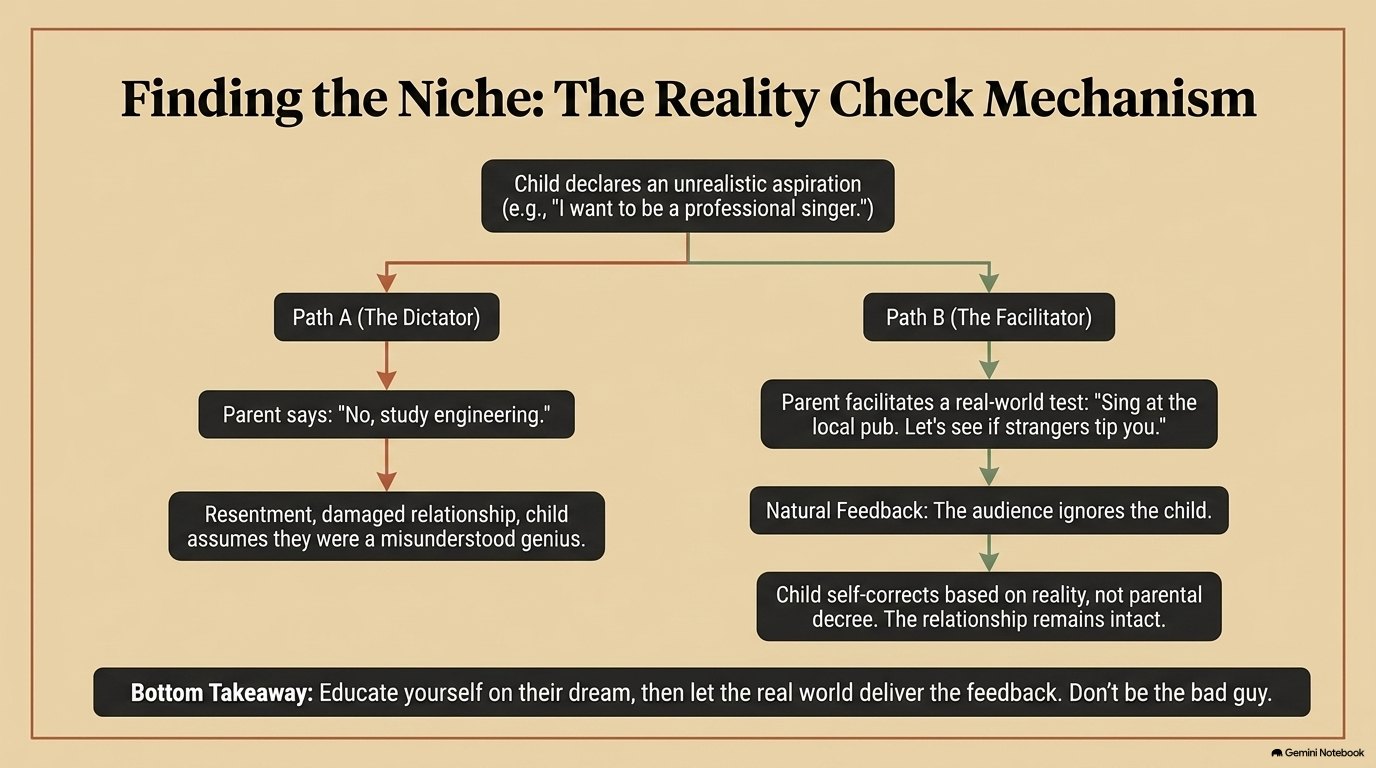
Both paths deliver the same information. Only one of them leaves the relationship standing, because the feedback comes from the world rather than from you. -
The important traits are imbibed, not taught.
Children learn grit by watching a parent work hard and care for the family. They learn honesty the same way — which is why the small white lie, the “tell them I’m not home”, does more damage than it appears to.
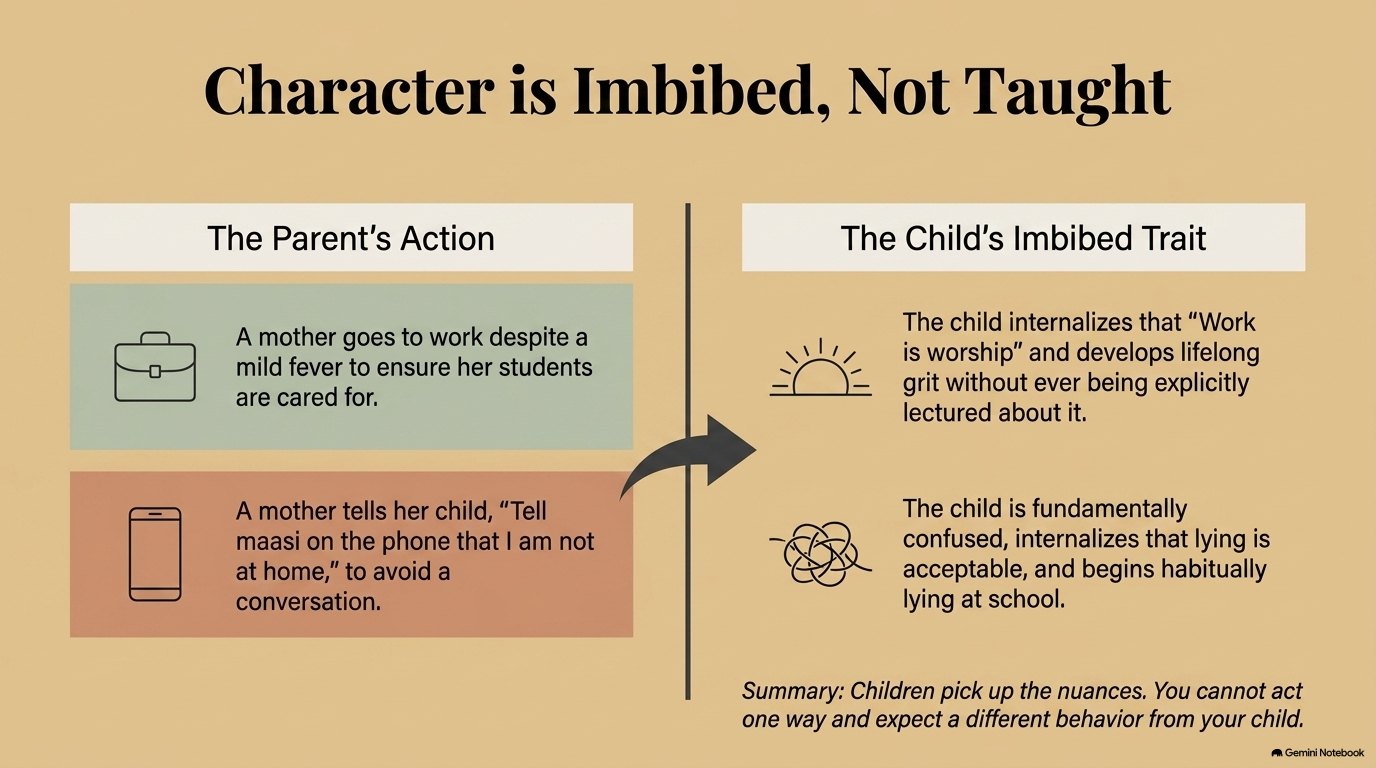
Two ordinary moments, two lifelong lessons. Neither was delivered as a lesson. -
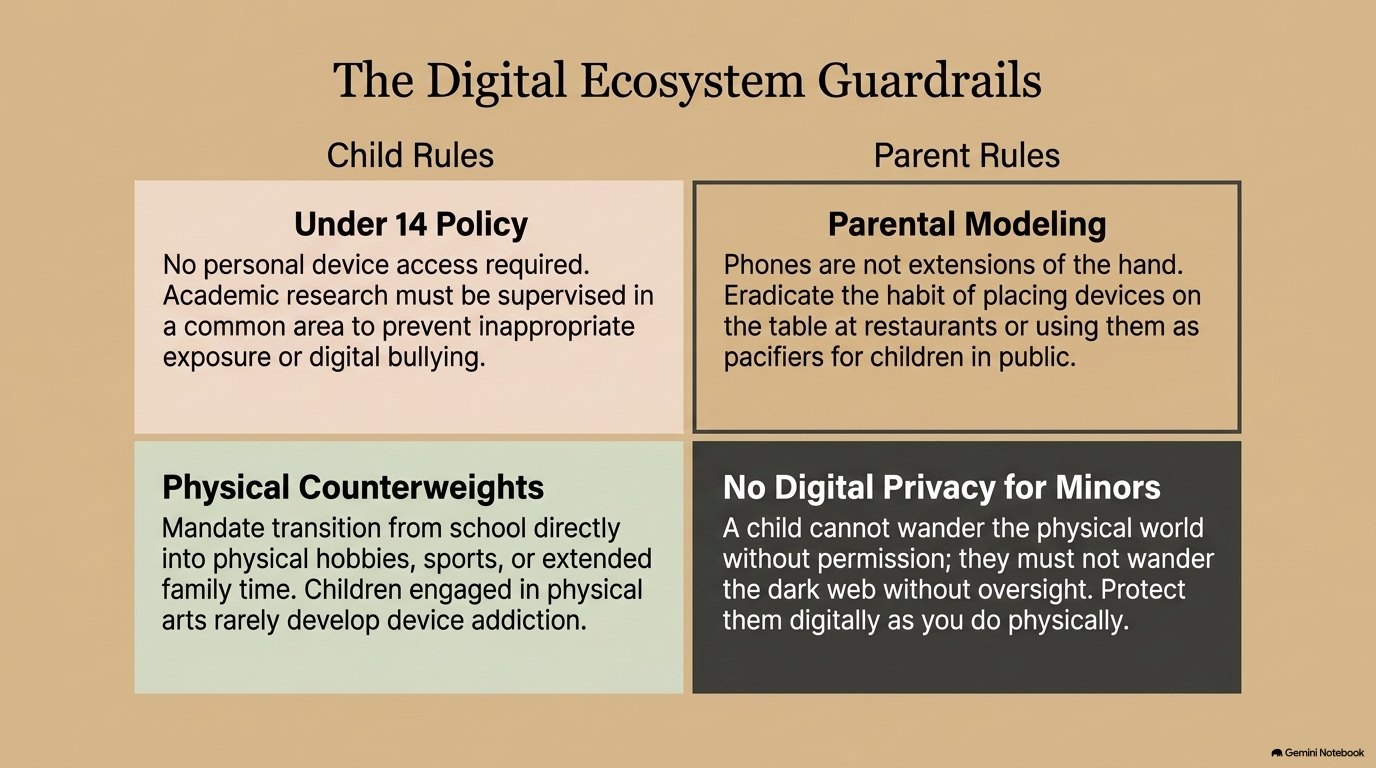
Under 14 or 15, there is little reason for a personal device.
Beyond supervised research, Ms. Misra sees no case for it. Heavy use, she warns, produces what she calls digital dementia in children — memory loss, sleep loss and forgetfulness, appearing in children as young as 11.
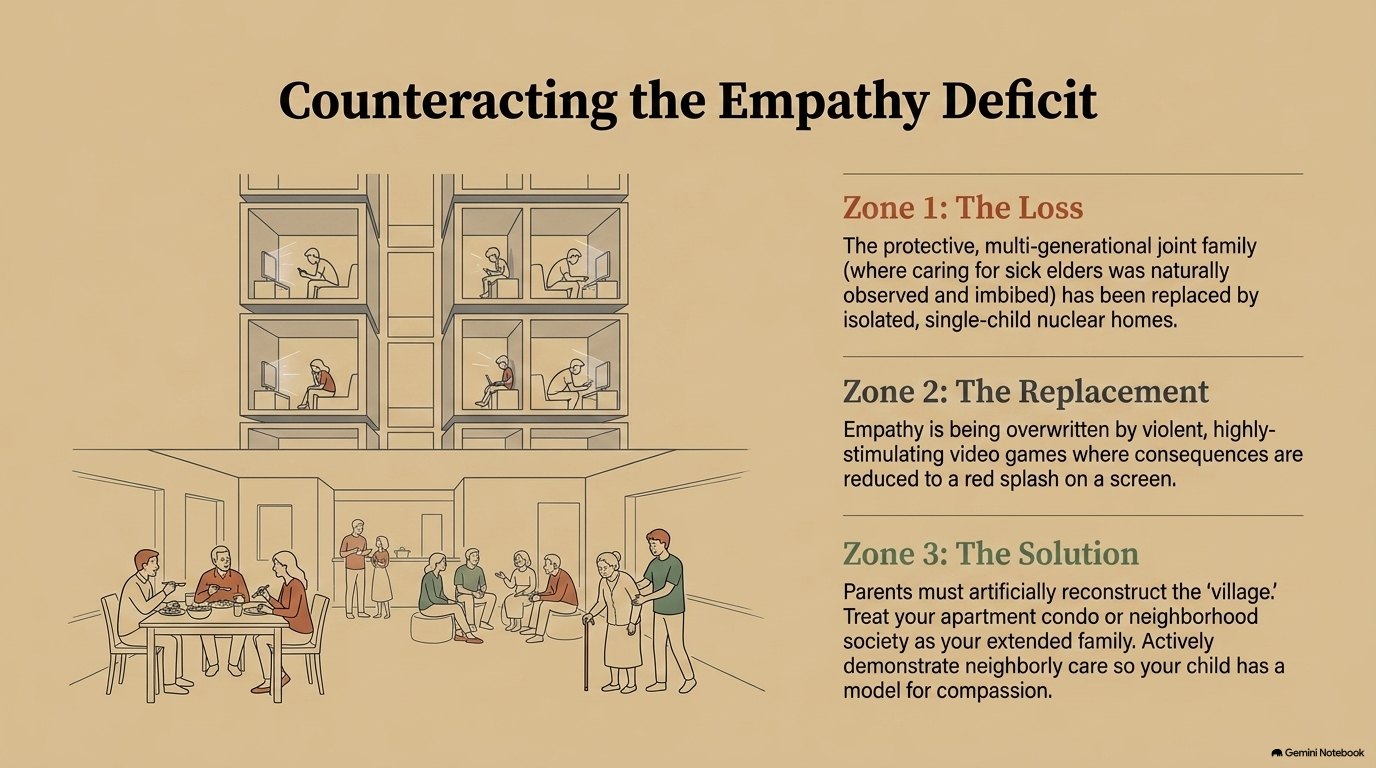
Her sharpest point here is about fairness: you cannot hand a child unlimited access and then demand a detox. The intervention has to come before the dependency, not after it. -
If they can’t go there physically, they can’t go there digitally.
Her test for cyber safety is that simple. Digital bullying and the dark web are real, and the same permission a parent would require for a physical destination should apply online. Note that half this grid is addressed to the adult.
Two of the four rules govern the parent, not the child — phones off the restaurant table, and never used as a pacifier. -
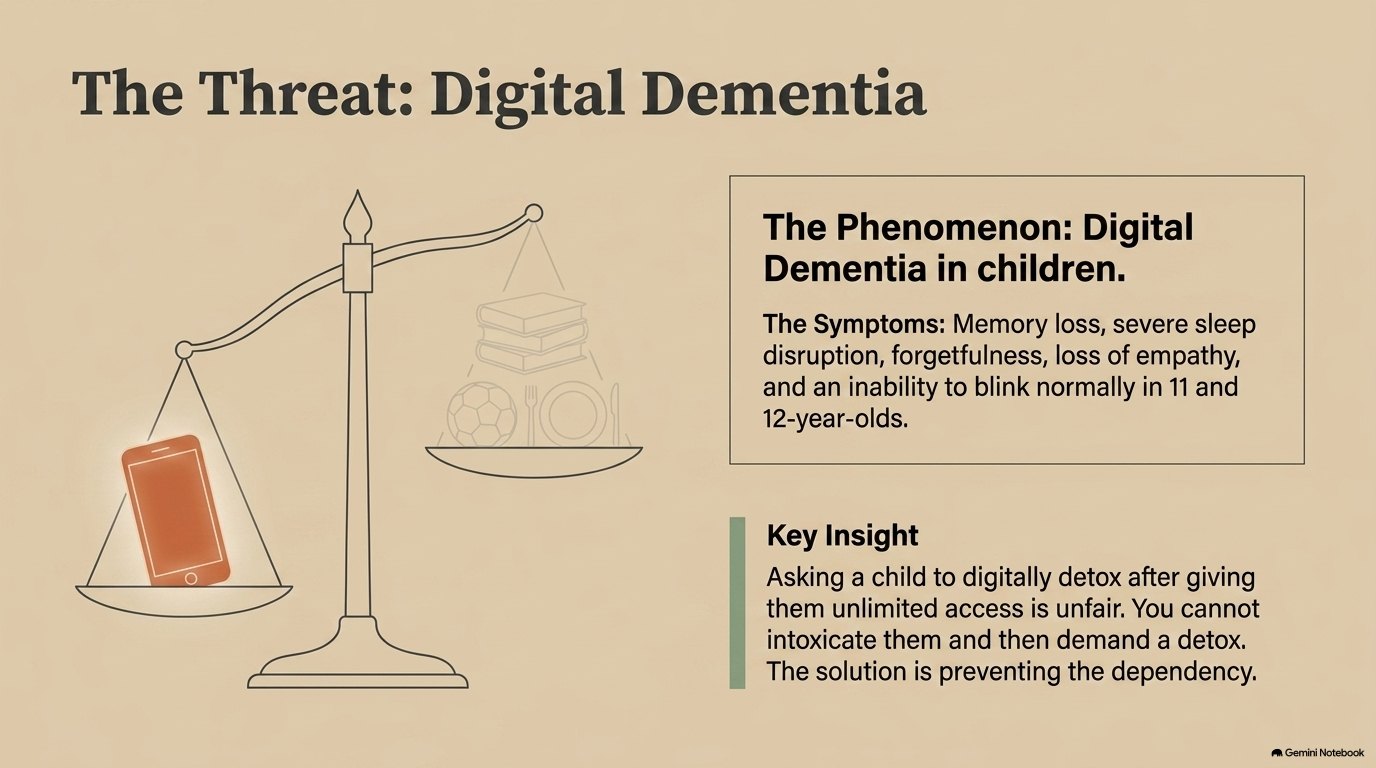
Rebuild the village deliberately.
The joint family taught empathy by accident: children watched adults care for sick elders and absorbed it. Nuclear, single-child homes removed that classroom, and violent games moved into the gap. Her answer is to reconstruct the village on purpose — treat the condo or the neighbourhood as extended family, and let the child watch you care for someone.
Empathy was never taught in the joint family. It was witnessed. Remove the witnesses and something else fills the slot. -
Fix the dinner table before fixing the child.
The most operational idea in the episode. Devices leave the room; the question is specific rather than generic; the bad part of the day gets discussed as openly as the good; and the parent answers the same question honestly. That last step is what converts a routine into trust.
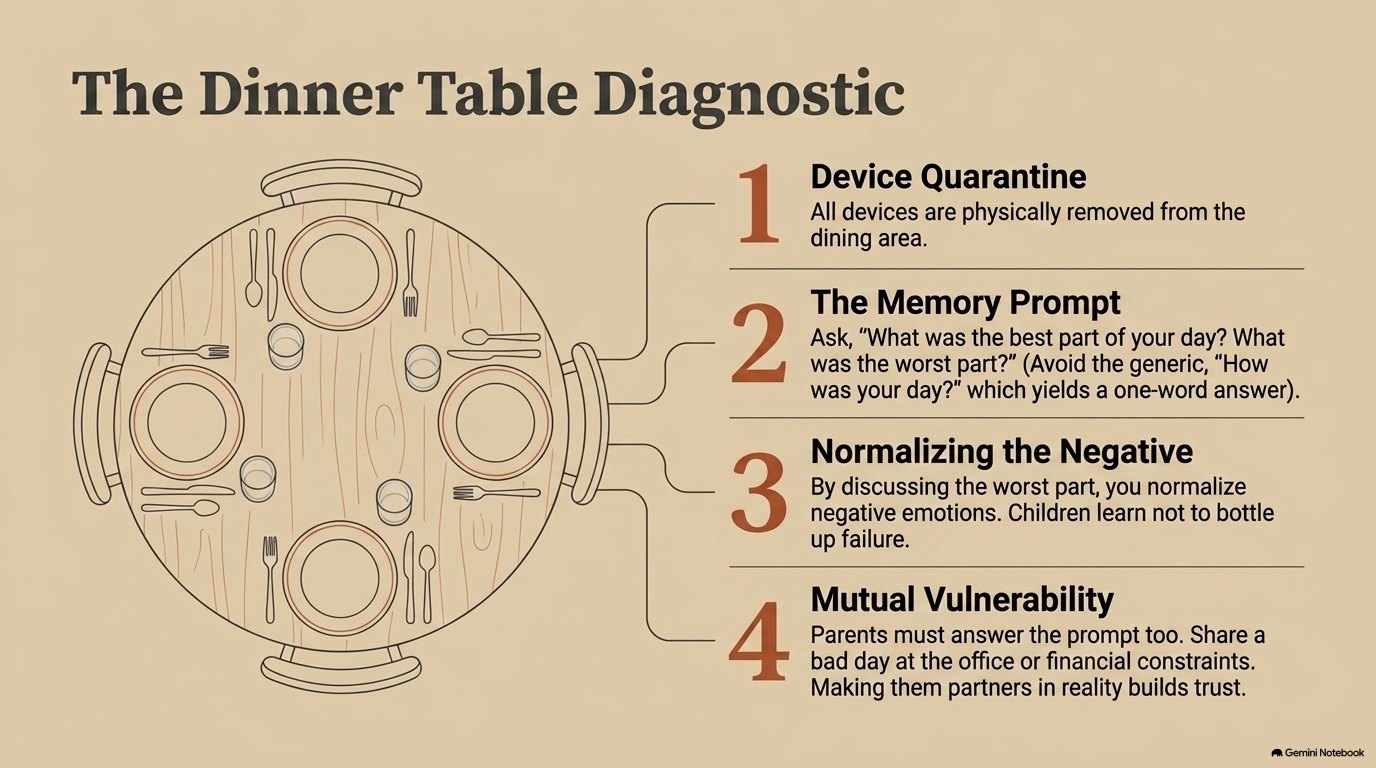
“How was your day?” earns a one-word answer. Asking for the best part and the worst part earns a conversation — and normalises the admission of a bad day. -
The future skills are human ones.
Dealing with change, collaboration, empathy, compassion and critical thinking. She singles out empathy as the counterweight to the casual, heartless treatment of death in violent video games, and notes that single children in particular have to be taught to share.
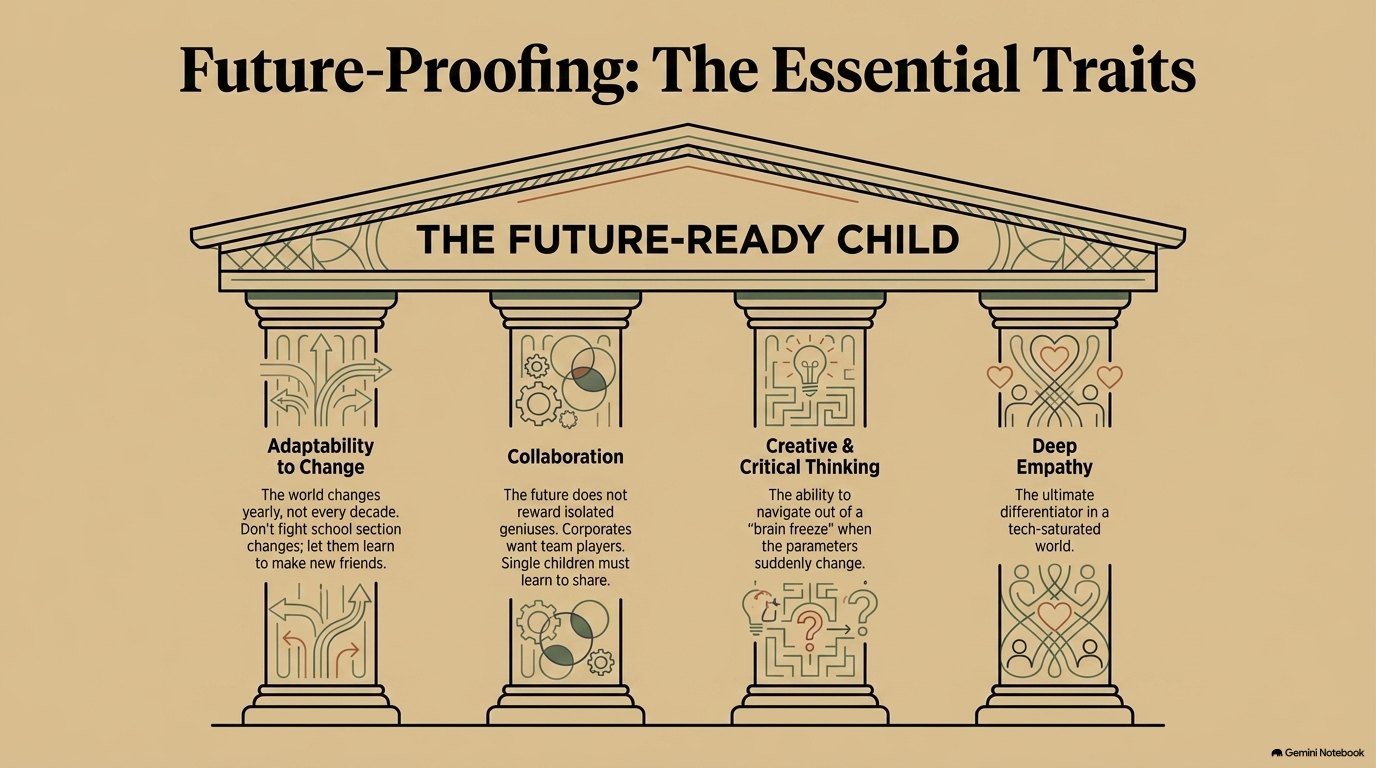
Four columns, one roof. Adaptability is the one parents most often fight — she suggests letting a child change class sections and make new friends rather than intervening. -
Accept the diversity in your own child.
Imposing a specific will — about IIT, about medical school, about marriage — alienates a child and can open a rift that does not close. When in doubt, she suggests, look back at how your own parents raised you, given you turned out well.
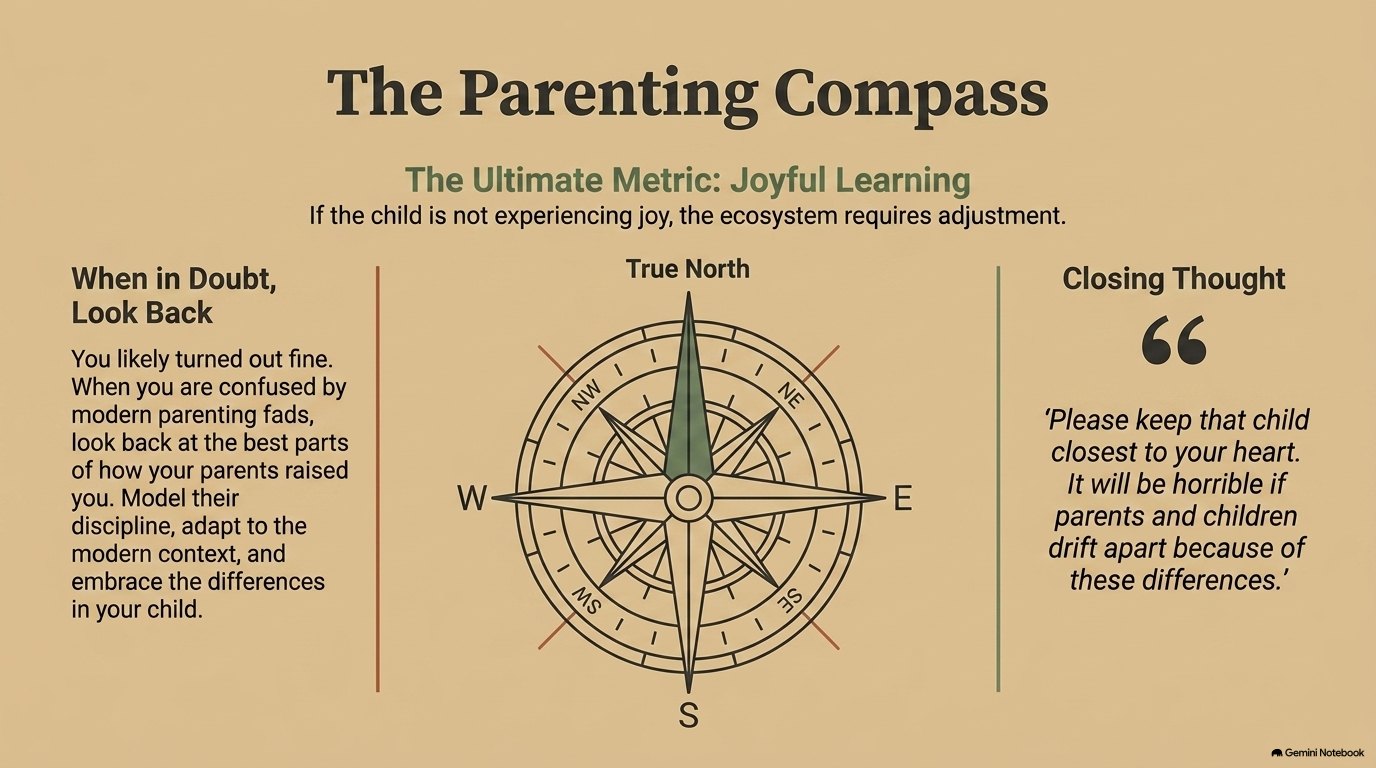
Her closing instrument. True north is not the marks; it is whether the child is experiencing joy. If they are not, something in the ecosystem needs adjusting.
If you only fix one thing
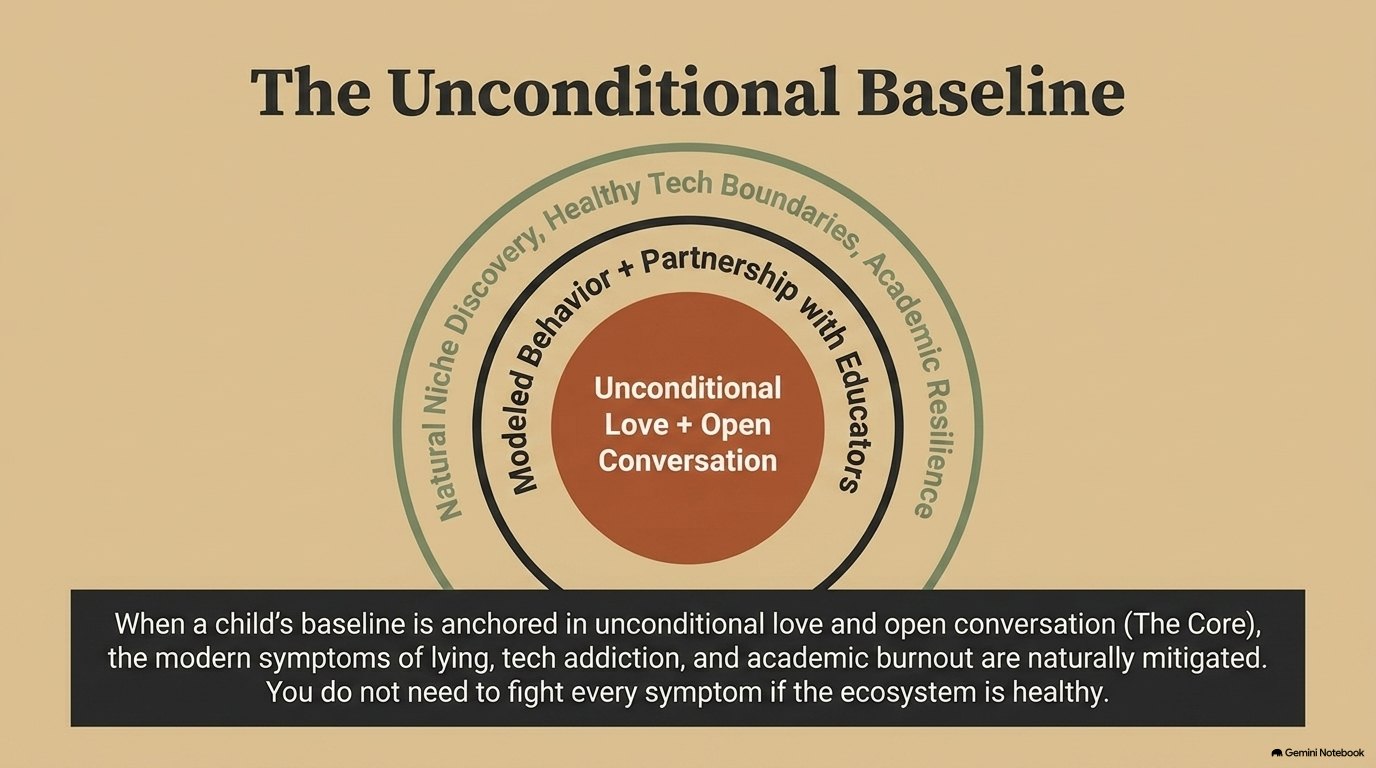
Every practice above sits on a single foundation. Her argument is that you do not have to fight each modern symptom — the lying, the device dependence, the burnout — one at a time. Secure the core and most of them lose their grip.
Chapters
Every timestamp opens the episode at that moment.
- 00:00The importance of parent–school partnership
- 01:54Parent–school partnership in action
- 12:56Navigating exam stress and academic pressure
- 18:59Helping children find their career path
- 23:12Motivating young learners: modern pedagogy
- 24:46Instilling values and traits in children
- 27:53Impact of parental behaviour
- 30:32Technology and parenting
- 35:21Understanding peer pressure and social media
- 39:49Parent engagement matters
- 40:45Skills children need for the future
- 44:09Rapid fire Q&A and key takeaways

Ms. Aditi Misra
School Director, DPS International, Gurgaon · Founder Principal, DPS Gurgaon
An alumna of DPS RK Puram, Ms. Misra graduated from Lady Shri Ram College and took her master’s from Delhi University in History and Education. She began teaching at DPS RK Puram in 1985 and has held leadership posts across several Delhi Public Schools — RK Puram, Vasant Kunj and Dubai — before founding and heading the Gurgaon schools. She is also a graduate of the Principals’ Training Centre, Miami.
- School Director, DPS International, Gurgaon
- Founder Principal, DPS Gurgaon
- Teaching career began at DPS RK Puram, 1985 — nearly four decades in education
- Recipient of the Teachers’ Award from CBSE; CBSE master trainer, and continues to train educators through the CBSE Centre of Excellence
- Karmaveer Chakra awardee · Maharatna award, iCONGO, 2019
- Has authored and ideated several children’s books on life skills, art education and social science
- Per the episode description, she is also an Ambassador for the British Council, was added to the CII Education Panel for 2024–25, and heads the Gurgaon chapter of the HPSC as its President

For Ms. Misra — and anyone who wants to feature this conversation
Everything you need to put this episode on your own site, press page or portfolio. No permission required; a link back is all we ask.
Embed the player and a link back
A one-line description you can reuse
Questions this episode answers
Why does Aditi Misra call the school-parent partnership non-optional?
Because the child is the beneficiary of it and the casualty without it. She says she has never seen parents as adversaries in the school - they are her partners. When teachers and parents work in sync, a child feels secure knowing both adults genuinely care for them, even when the guidance feels strict. It is also practical: on her first day as a principal, with 900 children and a chaotic dispersal, it was a parent standing up to support the teachers that calmed the crowd and stabilised the environment.
How should a school handle conflict with parents, such as a fee hike?
She describes a four-step sequence. First the trigger, a conflict such as a fee hike, an academic struggle or a disciplinary action. Second the pause: avoid knee-jerk opposition and schedule a face-to-face sit-down. Third the shared reality, where both parties present their view without judgment. Fourth the alignment, which she estimates resolves roughly 99.9 percent of conflicts once both sides realise their ultimate goal is identical - the child's welfare. Her own school used exactly this on a fee dispute, opening the auditorium and explaining the expenses transparently.
Is academic success inherited from high-achieving parents?
No. She is direct that success is not purely genetically inspired: children of high-achieving parents do not always become toppers, and children from basic backgrounds frequently excel. Treating results as hereditary sets up unfair expectations in both directions.
How should parents handle exam stress and academic pressure?
By separating love from marks. In the conditional pattern, love is proportional to results - 100 means praise and 40 means withdrawal - which produces pushback, anxiety and a child who hides failure. In the unconditional pattern, a 40 is a signal to evaluate what distracted the child rather than a reason to reduce affection, which produces confidence, open communication and self-correction. She also warns against equating happiness with high marks, a large house or a big car.
How can parents help a child choose a career without forcing one?
Let the real world deliver the feedback instead of the parent. If a child declares an unrealistic aspiration, the dictator path - 'no, study engineering' - produces resentment and a child who assumes they were a misunderstood genius. The facilitator path arranges a real-world test, such as singing where strangers can respond honestly. The child then self-corrects based on reality rather than parental decree, and the relationship stays intact. Educate yourself on their dream first, and do not be the bad guy.
What is digital dementia in children?
It is her term for what she observes in heavy device users: memory loss, severe sleep disruption, forgetfulness, loss of empathy, and even an inability to blink normally in 11 and 12-year-olds. Her key insight is about fairness - asking a child to detox after giving them unlimited access is unfair. You cannot intoxicate them and then demand a detox. The solution is preventing the dependency in the first place.
At what age should a child get a personal device?
Her position is that children under about 14 have no need for personal device access. Academic research should be supervised in a common area of the home, which prevents both inappropriate exposure and digital bullying. She pairs this with physical counterweights: move children from school directly into physical hobbies, sport or extended family time, because children engaged in physical arts rarely develop device addiction.
What is her rule for cyber safety and children's digital privacy?
A child cannot wander the physical world without permission, so they must not wander the dark web without oversight - protect them digitally as you do physically. She is explicit that minors do not get digital privacy. Half of her guardrails are aimed at parents rather than children: phones are not extensions of the hand, and should not be placed on restaurant tables or used as pacifiers for children in public.
What is the Dinner Table Diagnostic?
A four-step routine for daily family conversation. One, device quarantine: all devices are physically removed from the dining area. Two, the memory prompt: ask what was the best part of your day and what was the worst part, rather than the generic 'how was your day' which yields a one-word answer. Three, normalising the negative: by discussing the worst part, children learn not to bottle up failure. Four, mutual vulnerability: parents answer the prompt too, sharing a bad day at the office or a financial constraint, which makes the child a partner in reality and builds trust.
Why does she say character is imbibed rather than taught?
Because children absorb the nuances of what adults actually do. A mother who goes to work despite a mild fever so her students are cared for teaches that work is worship, and the child develops lifelong grit without ever being lectured. A mother who tells a child to say she is not at home teaches that lying is acceptable, and the child begins habitually lying at school. You cannot act one way and expect different behaviour from your child.
How can parents counteract the empathy deficit?
She traces the loss to the disappearance of the multi-generational joint family, where caring for sick elders was naturally observed and imbibed, replaced by isolated single-child nuclear homes. Meanwhile empathy is being overwritten by violent games in which consequences are reduced to a red splash on a screen. Her solution is to artificially reconstruct the village: treat your apartment complex or neighbourhood society as extended family, and actively demonstrate neighbourly care so the child has a model for compassion.
Which skills does she consider essential for the future?
Four. Adaptability to change, because the world now changes yearly rather than by the decade - she suggests not fighting school section changes and letting children learn to make new friends. Collaboration, because the future does not reward isolated geniuses and single children in particular must learn to share. Creative and critical thinking, the ability to navigate out of a brain freeze when the parameters suddenly change. And deep empathy, which she calls the ultimate differentiator in a tech-saturated world.
What is the single thing parents should get right?
Anchor the child's baseline in unconditional love and open conversation. She argues that when that core is secure, the modern symptoms - lying, tech addiction, academic burnout - are naturally mitigated. You do not need to fight every symptom if the ecosystem is healthy.
What is her final message to parents?
Look back when in doubt: you likely turned out fine, so model the best parts of how your own parents raised you and adapt them to the modern context. Accept your child's differences rather than imposing a specific will about IIT, medical school or marriage. Her closing thought is to keep that child closest to your heart, because it would be horrible for parents and children to drift apart over these differences. The ultimate metric is joyful learning - if the child is not experiencing joy, the ecosystem requires adjustment.
About these notes
This page is a set of structured episode notes and framework diagrams rather than a word-for-word transcript. Everything above reflects the substance of the conversation, and the quoted lines are reproduced as they appear in The Partnership Playbook, the deck built from this episode. For the full conversation in her own words, watch the episode — the chapter links jump straight to any section.
These conversations inform the method
The frameworks used in school workshops are tested against the people building the field. If you want that thinking in your staffroom, start here.
More from The Learning Circle
Dr. Ashok K. Pandey
Why India’s schools have a mentoring problem, not a training problem.
Dr Vandna Shahi
National Award to Teachers 2022. Teacher training and professional development under NEP.
Dr Lakshmi Kumar
Founder Director, The Orchid School, Pune. Student wellbeing in the age of social media.
Subir Shukla
Principal Coordinator, Group Ignus. Educational evolution, challenges and future directions.
Bringing this conversation into your school
Credo Learnings runs whole-staff and individual-teacher workshops on using AI as a thinking partner, built on the IMPACTS framework. Get in touch to talk it through.
Cite this episode
Kaur, K. (Host). (2025, September 4). Why parents are the key to education success [Audio / video podcast episode]. In The Learning Circle. Credo Learnings. https://www.kavleenkaur.com/the-learning-circle-aditi-misra